How to Maintain Healthy Lawn Grass: 2026 Guide
Table of Contents
- Step 1: Test Your Soil Before You Do Anything Else
- Step 2: How Often Should I Water My Lawn?
- Step 3: Best Mowing Height for Grass and Mowing Technique
- Step 4: Feed Your Lawn: Fertilizing and Nutrient Management
- Step 5: Lawn Care Schedule by Season
- Step 6: Lawn Weed Prevention That Actually Works
- How to Diagnose Common Lawn Problems
- Frequently Asked Questions
Last Updated: October 12, 2026
Step 1: Test Your Soil Before You Do Anything Else
To maintain healthy lawn grass, start with the soil, not the grass. Soil testing is the most skipped step in lawn care, and it decides everything else. At Pickard's Lawncare LLC, we've spent over 30 years watching homeowners pour money into fertilizer and seed while the real problem sat six inches underground.
A soil test costs little and tells you exactly what your lawn is missing. Without it, you're guessing.
How to Pull a Soil Sample
Testing takes about 15 minutes:
- Grab a clean bucket, a trowel, and a soil probe or garden spade.
- Dig 6 to 8 spots across the yard, each 4 to 6 inches deep.
- Mix all the cores together in the bucket.
- Spread the mix on a paper plate to dry overnight.
- Bag about a cup and send it to your county extension office or a private lab.
Don't sample right after fertilizing. Wait at least six weeks for accurate results.
Reading the Results and Choosing Amendments
Your lab report shows pH, phosphorus, potassium, and often micronutrients. Most lawns prefer a pH between 6.0 and 7.0. Lime raises acidic pH; sulfur brings alkaline soil down.
For nutrients, the report tells you how much phosphorus and potassium to add.
For organic matter, spread a half-inch of compost over the lawn in fall. It feeds soil microbes and improves water holding.
Step 2: How Often Should I Water My Lawn?
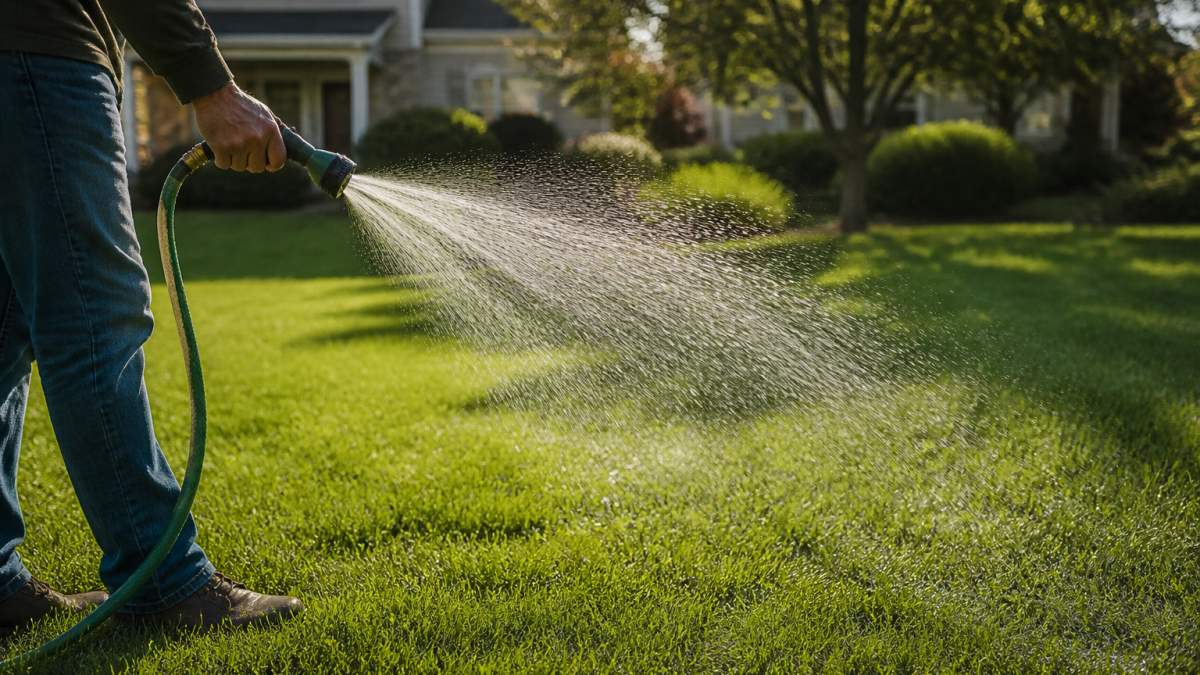
Water your lawn deeply once or twice a week, about one inch per session. Shallow, daily sprinkling is the fastest way to grow shallow roots and a weak lawn.
The goal is one inch of water per week, including rainfall. Deep watering pushes roots down. Deep roots survive heat and drought far better than surface roots.
Here's how to measure it:
- Set out a few tuna cans or rain gauges around the yard.
- Run your sprinkler for 30 minutes and check the depth.
- Adjust your runtime until each can holds about one inch.
Signs Your Lawn Needs More Water
Your grass tells you when it's thirsty:
- Footprints stay visible after you walk across the lawn
- Grass blades curl inward or turn a dull blue-gray
- The lawn springs back slowly when you step on it
If you see these, water deeply the next morning. Don't water at night, since wet blades invite fungus.
Step 3: Best Mowing Height for Grass and Mowing Technique
The best mowing height for grass depends on your grass type, but the rule is simple: never cut more than one-third of the blade at once.
Cool-season grasses like tall fescue do best at 3 to 4 inches. Warm-season grasses like Bermuda and zoysia prefer 1 to 2 inches.
A few technique rules that matter:
- Keep your mower blade sharp. A dull blade tears grass and invites disease.
- Change your mowing direction each time to avoid ruts.
- Leave grass clippings on the lawn. They return nutrients for free.
Mowing is where most homeowners quietly wreck a good lawn. It's not how often you cut, it's how much you take off.
Step 4: Feed Your Lawn: Fertilizing and Nutrient Management
Fertilize based on your soil test, not a calendar. That's the difference between a healthy lawn and a burned one.
Most lawns need nitrogen most, plus phosphorus and potassium per your test.
Watch your application rate. Too much nitrogen pushes fast, weak growth that disease loves. Too little leaves grass thin and pale.
The EPA guidance on nutrient pollution notes that excess nutrients wash into waterways, so applying only what your lawn needs protects both your grass and local water.
Step 5: Lawn Care Schedule by Season
A lawn care schedule by season keeps you ahead of problems instead of reacting to them. But the calendar that matters is tied to your grass type and local climate, not a generic table.
Use the tables below as a framework, then shift the timing to match your first and last frost dates. Your county extension office publishes local frost dates and a lawn calendar tuned to your area, that local version always beats a national one.
Cool-Season Grass Calendar (Tall Fescue, Kentucky Bluegrass, Perennial Ryegrass)
Cool-season grasses grow hardest in spring and fall and slow down or go dormant in summer heat.
| Month | Main Tasks | Why It Matters Now |
|---|---|---|
| Late Feb-Mar | Light nitrogen feed as growth resumes; pre-emergent before soil hits 55°F | Feeds grass, not weeds; blocks crabgrass before it sprouts |
| Apr-May | Mow at 3-4 inches; water deeply if rainfall is short; spot-treat broadleaf weeds | Grass is competitive now; shallow watering wastes the window |
| Jun-Aug | Raise deck to 4 inches; water 1 inch per week; skip heavy nitrogen | Heat and drought survival; nitrogen in peak heat feeds disease |
| Sep-Oct | Aerate, overseed, apply the year's heaviest nitrogen feeding; lime if the soil test calls for it | Soil is warm, air is cool, peak root growth |
| Nov-Dec | Final mow at 2.5-3 inches; clean up leaves; stay off frozen turf | Prevents snow mold and matting; protects crowns |
Warm-Season Grass Calendar (Bermuda, Zoysia, St. Augustine, Centipede)
Warm-season grasses green up late, thrive in heat, and go dormant after the first hard frost.
| Month | Main Tasks | Why It Matters Now |
|---|---|---|
| Mar-Apr | Rake out dead topgrowth; pre-emergent as soil hits 55°F; first light feed at full green-up | Clears the way for new growth; stops summer weeds early |
| May-Jun | Mow at the low end of the range for your species; water 1 inch per week; main nitrogen feeding | Active growth phase, grass can use the nutrients |
| Jul-Aug | Mow high end of range; water deeply; watch for chinch bugs and grubs | Peak stress period; pests are most active |
| Sep-Oct | Second nitrogen feeding; overseed only if you have warm-season seed and 60+ days before frost | Stores energy for winter; overseeding too late wastes seed |
| Nov-Feb | Stop fertilizing; mow only if growth continues; avoid traffic on dormant turf | Dormant grass cannot recover from damage |
Transition-Zone Adjustments
If you live where cool- and warm-season grasses overlap, you may manage both, for example, tall fescue in shade and Bermuda in full sun. Run two calendars side by side and treat each zone separately, since the mowing height and feeding schedule that helps one will hurt the other.
Spring Lawn Care
Rake out dead material and check for bare patches. Apply a light feeding once the lawn is actively growing, not before, feeding dormant grass wastes product and can feed weeds. Hold off on heavy spring nitrogen, which pushes weak topgrowth at the expense of roots.
Summer Lawn Care
Water deeply and mow high. Raise your mower deck by half an inch to shade the soil and cool the crowns. Skip fertilizer in peak heat unless your soil test calls for it, and watch for drought stress and pests rather than pushing growth.
Fall Lawn Care
Fall is the best time to aerate and overseed cool-season grass. Roots grow hard in cool soil, and the grass has months of mild weather to establish before winter. It's also the right window to correct pH with lime, which needs time to move into the soil profile before spring.
Step 6: Lawn Weed Prevention That Actually Works
Lawn weed prevention starts with a thick, healthy lawn, not a spray bottle. Weeds move into thin, weak turf. Fix the grass and most weeds lose their foothold.
What actually works:
- Mow high to shade out weed seeds
- Water deeply so your grass outcompetes weeds for moisture
- Aerate compacted soil so roots can spread
A pre-emergent barrier stops crabgrass and similar weeds before they sprout. Timing is everything. Apply too late and the seeds have already taken hold.
How to Diagnose Common Lawn Problems
Most lawn problems trace back to water, soil, or mowing, in that order. Diagnose in that sequence and you'll solve the real issue faster than guessing at products, matching symptom to mechanism rather than label.
Start With a Three-Question Check
Before you buy anything, answer these:
- Is the soil moist 4 inches down? Push a screwdriver into the turf. If it slides in easily, water is not the problem. If it resists, you likely have drought stress or compaction.
- Did the problem appear suddenly or gradually? Sudden onset points to pests, disease, or a spill. Gradual decline points to soil, pH, or fertility.
- Is the pattern uniform or patchy? Uniform yellowing suggests a nutrient or pH issue. Patchy, irregular damage suggests pests, disease, or localized compaction.
Symptom-to-Cause Guide
| Symptom | Most Likely Cause | How to Confirm | First Response |
|---|---|---|---|
| Footprints stay visible; blades curl or turn blue-gray | Drought stress | Screwdriver test, soil dry 4 inches down | Water deeply the next morning; recheck in 3 days |
| Brown patches that pull up like carpet | White grubs | Lift a square foot of turf at the edge; count grubs | Treat per label; water in; recheck in 2 weeks |
| Brown patches that stay rooted; irregular shape | Disease (often brown patch or dollar spot) | Look for lesions on blades in early morning dew | Reduce evening watering; improve airflow; treat if spreading |
| Uniform yellowing, slow growth | Nitrogen shortage or poor drainage | Soil test; check for standing water after rain | Feed per soil test; aerate if compacted |
| Yellowing between veins on new growth | Iron deficiency, often from high pH | Soil test for pH above 7.0 | Lower pH with sulfur per label; do not guess |
| Moss spreading in shade | Shade, compaction, or acidic soil | Soil test; note sun hours per day | Aerate; raise pH if low; consider shade-tolerant grass |
| Thin, patchy turf in sun | Compaction or heat/drought stress | Screwdriver test; check traffic patterns | Aerate; overseed in the right season |
| Weeds everywhere | Thin turf from any of the above | Walk the yard; note bare and thin zones | Fix the underlying cause before spraying |
Look-Alikes That Fool Homeowners
- Drought stress vs. grub damage: Both produce brown patches. Drought patches stay rooted and recover with water. Grub-damaged turf lifts like a loose carpet because the roots are gone.
- Nitrogen shortage vs. iron deficiency: Both yellow the lawn. Nitrogen shortage yellows the oldest blades first and is uniform. Iron deficiency yellows new growth between the veins and often tracks with high pH.
- Disease vs. dog spots: Dog urine creates a green ring with a dead center. Disease patches are irregular and often have visible lesions on the blades.
When to Call a Professional
If you've confirmed moisture is adequate, corrected pH and fertility per a soil test, and the problem still spreads, the next step is a diagnosis you can't do from the surface, grub counts, disease identification under a hand lens, or compaction readings.
For tough cases like compacted soil, aeration opens the surface so water, air, and nutrients reach the roots. The Clemson University Extension home and garden information offers region-specific lawn guidance for homeowners across the Southeast, including the transition zone where cool- and warm-season grasses overlap.
If you'd rather hand off the guesswork, that's where we come in. Pickard's Lawncare LLC handles soil correction, aeration, mulching, and full property upkeep for homes and commercial sites.
Frequently Asked Questions
How often should I water my lawn?
Most lawns need about one inch of water per week, including rainfall. Water deeply once or twice a week rather than lightly every day. This encourages deep roots and a healthier lawn. In hot, dry periods, you may need to water every three to four days. Check soil moisture by pushing a screwdriver into the ground; if it goes in easily, you can wait.
What is the best mowing height for grass?
The best mowing height depends on your grass type. For cool-season grasses like tall fescue, keep it 3 to 3.5 inches. For warm-season grasses like Bermuda, 1 to 1.5 inches works well. Never cut more than one-third of the blade height at once. Taller grass shades the soil, reducing weeds and drought stress, which helps maintain healthy lawn grass.
How can I prevent weeds from taking over my lawn?
Lawn weed prevention starts with a thick, healthy lawn. Mow at the proper height, water deeply and infrequently, and fertilize based on soil test results. Apply pre-emergent herbicides in early spring before weed seeds germinate. For existing weeds, spot-treat with post-emergent products. Aerating and overseeding in the fall also helps fill bare spots and crowd out weeds naturally.
What should I do for my lawn in each season?
Spring: apply pre-emergent, fertilize, and start mowing. Summer: water deeply, mow high, and watch for pests. Fall: aerate, overseed, and apply a winterizing fertilizer. Winter: keep leaves off the lawn and avoid walking on frozen grass. Following a lawn care schedule by season keeps your grass resilient year-round and simplifies maintenance.
A healthy lawn isn't about one product or one weekend of work. It's a season-long habit of testing, watering deep, mowing high, and feeding on your soil's terms. If you'd rather have it handled by a team that's done it for more than 30 years, Pickard's Lawncare LLC offers a free quote for lawn care, mulching, tree cutting, and pressure washing. Get started with Pickard's Lawncare LLC and let us build a lawn care plan around your soil and your schedule.
More From Our Blog
- Average Cost of Professional Tree Removal: 2026 Pricing Guide
- Lawn Care Services in North Carolina: A Complete Guide
- All articles
Call 336-432-0023 or request a free quote.